
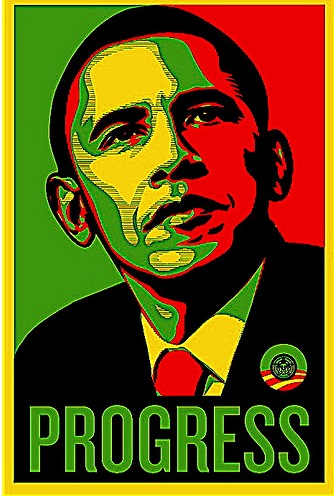
 skin to suggest change in US attitudes and that, essentially, her policies and pursuit of self-interest in the wider world will continue.
.
.
Obama: more than a colour problem.
.
.
.
.
The idea of state, borders and hegemony in any nation's foreign policy is called realpolitik; that hardened sense of self-interest is what has driven the United States' neo-imperialistic actions for a hundred years or more. The federal government of that nation throughout the 20th Century has attempted to impose its prevailing ideology upon its own people and also the rest of the planet, such that any alternative view or movement to freely pursue any other kind of political format is either stillborn by the efforts of the malicious midwifery of the CIA or subjected to such harsh conditions in its infancy, that it grows up in its parent communities or nations as a hardened, brutal and untrusting youth; like many a youth who has a healthy view to maintaining an element of freedom in their life, it may resort to aggressive means, if necessary, as the only viable route towards maturity. (My simple example would be Soviet Russia, which in reaction to Great War developments, threw off Imperialism in pursuit of Internationalism, only to be ostracized by Capital and driven into a defensive corner which preceded the 'paranoia' of Stalinism.)
There are historians who could reel off the top of their heads the instances of intervention by the US in scores of countries since its cynically late intervention in World War II. Some of the more widely known are the Phillipines, Korea, Vietnam, Cuba and a host of South American nations. The excuses used for intervention, militarily or otherwise, are variously labelled 'democracy', 'freedom', 'rights' over perceived 'oppression' and, by extension, 'good' over 'evil'. These are certainly emotive terms, rallying terms, values held by the majority of us, I suspect, as worth fighting for. If we consider that those countries which have been subject to the attentions of the US and its allies in the aforementioned ways might just have the same desire for democracy, freedom, rights and the common good as the electorate of the US, then surely there must be common ground upon which to use diplomacy to resolve contentious issues. Is it not so that the whole community of nations has to deal with a wholly more pressing problem, one that involves protecting the environment in order to make life viable at all?
So, 'congratulations' to President Obama, but we know that he has so many hurdles to overcome: entrenched opposition from narrow-minded bigotry; self-interested individuals backed by corporations that seem to hold the short-term satisfaction of shareholders or vested interests in overseas markets over longer-term imperatives for the planet; a pervasive PR-influenced national ideology that sees socialism in any form as creeping Stalinism, which itself was an example of what happens to youthful nations subject to vitriolic criticism and the most aggressive forms of realpolitik.
Recommended reading: Chomsky, N. (1997). World Orders, Old and New London: Pluto
Oh Obama!
David Bromwich writes as if Obama’s main problem were a deluded search for bipartisanship in the face of intransigent Republican rascals – Rush Limbaugh, Dick Cheney, Fox TV and so forth (LRB, 22 October). It might be better to admit that the left has deluded itself into believing that Obama, a nice, eloquent young man from Harvard with no gubernatorial and little legislative experience, has some sort of magic wand, when the truth is that he’s out of his depth. He is, unfortunately, just one more Democrat who campaigned on a promise to change everything about the way Washington works. However popular that theme may be, it is ignorant and naive. The Washington political system has proved to be extremely resilient. You can huff and puff about change and chant ‘Yes we can’ as much as you like but the system will remain resolutely intact. History shows that the politicians who get results are the ones who understand the system best and are the best at making it work for them. LBJ is the classic example.
Similarly, a better sense of realpolitik and less reliance on eloquence would get Obama further in foreign policy. It’s no good just announcing a plan to solve things in the Middle East. The Israel-Palestine conflict is part of a long holy war which can only be managed at best, not solved. Serious advances are usually born of crises, such as the Yom Kippur war. The next opportunity may be an Israeli war with Iran.
As it is, here we are with Guantánamo Bay still in operation, the Afghan war likely to go on and get bigger, no progress at all in the Middle East, US unemployment over 10 per cent and healthcare perhaps already doomed. The collapse in Obama’s ratings suggests he could well lose the mid-term elections. And of course Jimmy Carter is right: some of that visceral reaction is bound to be racist. Hard to see how it could be otherwise.
It’s extraordinary how the Democrats keep on doing this. Jimmy Carter started it by ‘running against Washington’ – an understandable stance after Watergate – but all it really meant was that he made a hopeless hash out of relations with Congress and his legislation got nowhere. Remember his energy independence bill which he declared to be MEOW (the moral equivalent of war)? It got absolutely nowhere. It was the same with Clinton. Imagine being stupid enough to start off affronting all manner of powerful pressure groups by making gays in the military the first issue you tackle. Or being even more stupid in putting your wife in charge of health reform. If he wanted to do that, fine, but he would have had to do what JFK did with Bobby, make him a fully accountable cabinet member with the advice and consent of the Senate. To hand such a key area of reform to his wife and for her to remain an unaccountable private citizen was ludicrous.
The common factor, of course, was that both Carter and Clinton were Southern governors of smallish states in which the governor gets his budget through and then uses his patronage to do whatever he wants, utterly dominating the state legislature. Both seemed to imagine that being president wouldn’t be very different and that you could use cronies for everything. Obama’s own background as a community worker and campaigner isn’t any more appropriate, and giving foreign affairs over to Bill Clinton’s wife may not have been clever: thus far her diplomatic abilities don’t appear much greater than they were in healthcare reform. I fear a great disappointment is in the making.
R.W. Johnson
Cape Town
Cape Town


No comments:
Post a Comment