
I’m still yet to finish the book and I hope to have avoided any spoilers in the following review.
A novel which, as novels should, builds for its reader a rounded world, particular of place, character and action. The story is that of a family of Kashubians (an ethnically ill-defined group neither fully Polish nor German) set against that rich vein for writers, the rise and fall of Nazism and its disruptive effects on the whole of Europe. Our narrator, biographer and central character is the diminutive, manipulative Oskar, a monster child reminiscent for me of the baby in the television cartoon series Family Guy, who grows to adulthood during the course of the story yet not beyond three or four feet in height and whose attachment to a succession of tin drums and whose vocal talent for shattering glass is central to the plot.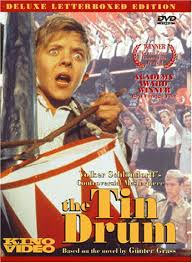

There is something archetypal about Nazism as linked with our current categories of Good and Evil. I don’t find those categories very useful and neither, I think, does Grass. We’ve heard so much rhetoric from the likes of Bush and Blair on the ‘Axis of Evil’ and about ‘evildoers’, but in actuality indiscriminate violence is meted out mercilessly by both sides in this so-called War on Terror in which we are embroiled. There are of course, parallels with World War II. ‘Evil’ is a term that has been applied readily to the German volk who were deemed to have behaved generally poorly during those years. Had we, however, as individuals been there, might we have been camp guards, members of the Party, Waffen SS soldiers? We witness in this novel people behaving as people do and with the capacity to do good and bad things. This is why the book shows us invading Russian soldiers behaving at once tenderly, brutally and indifferently and Allied bombs blowing to smithereens characters that we have come to like. For me, one of the most sympathetic characters is Oskar’s cuckolded father Matzerath, loving family head, grocer, wonderful cook… and Nazi; Maria seems to me to be the most virtuous character, yet by many standards she would be considered amoral and her behaviour as nothing other than pure praxis. I heard not so long ago a radio interview conducted with Grass, in which he claims that there is no symbolism in the novel - that the drum, for instance, doesn’t stand for anything in particular. I can accept this to be the case, but Oskar himself must stand for something about the way a person, in extremis permanently, will do what needs to be done to survive. The matter-of-fact way Oskar describes the macabre events that punctuate his existence, tells us less about his persona than about how callousness might overtake any one of us under certain conditions.
Clearly, this book might be labelled ‘magic realism’, like a Gabriel Garcia Marquez or Angela Carter, and therein, perhaps, lies its page-turning quality, but it is generally subtler than those others and more believable; because the narrator is untrustworthy, mentally unstable, and unkind to many of those around him, why should he not, too, deceive us the reader by being an unreliable narrator and might he not embellish, for instance, the glass-altering powers of his voice to the point where implausible becomes impossible? Notwithstanding the literary tropes used in what is after all a work of fiction, Grass paints us a visceral picture of another time and place, of people different from us but sharing the same imperatives, upon the well-worn but endlessly intriguing thematic canvass of humanity and its condition. Grass isn’t Dostoevsky, but The Tin Drum is certainly a major piece of literature; the prose, even in translation (and dogged occasionally in my copy with typos), is consistently inventive and well-honed. I read relatively few novels, but this has become one of my favourites.
http://www.newstatesman.com/books/2010/02/tin-drum-germany-grass-manheim There's now a new author-authorised translation.

